Allergens
Pollen, dust mites, pet dander, and mold spores can circulate throughout the home.


Dust, pollen, pet dander, smoke particles, mold spores, bacteria, and other contaminants can circulate through a central HVAC system. Whole-home air purification treats the air whenever the system fan operates—not only the air in one room.
Your heating and cooling system can do more than adjust the temperature. An in-duct purifier adds air-treatment technology to the equipment that already circulates air through your home.
Watch the product video, then talk with State Automatic about whether HALO-LED fits your equipment and indoor-air priorities.
Ask About HALO-LEDPress play to watch. The video starts only when you choose.
Different technologies address different particle sizes and contaminant types, which is why product selection should start with the household’s concerns and HVAC system.
Pollen, dust mites, pet dander, and mold spores can circulate throughout the home.
UV and other technologies can address certain airborne biological contaminants.
Cooking, pets, smoke, and household products can create lingering indoor odors.
High-efficiency media filters capture smaller dust and smoke particles than many basic filters.

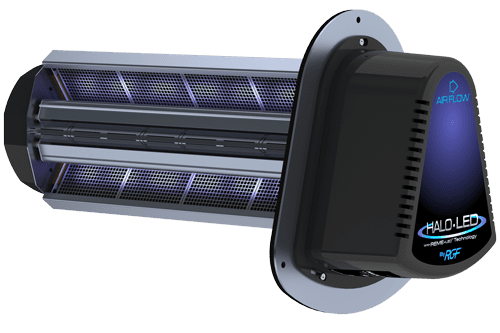
HALO-LED uses RGF’s REME-LED technology in a unit installed within the duct system. It offers another treatment option alongside the filtration already serving your home.
Choosing the right setup starts with your existing equipment. We consider installation space, electrical requirements, airflow, and ongoing care before recommending a product.
Media filters physically capture particles. UV systems address biological material in the treated air stream or on HVAC surfaces. A combined approach can provide broader coverage.
The device must fit the ductwork, preserve suitable airflow, and operate safely with the heating and cooling equipment.
Select filtration that balances particle capture with acceptable resistance for the blower and duct system.
Position the purifier or media cabinet where the system can treat return air effectively.
Test the installed system and explain the required filter, lamp, or component schedule.
A home in Mill Creek and an older property near downtown Batavia may need different improvements. We consider the building, daily routines, and HVAC system together, so each recommendation addresses a specific concern.
When pollen, pet dander, or settled dust is the concern, filter selection deserves a close look. Carrier Infinity® air purifier options can be evaluated alongside other filtration choices, with attention to cabinet fit, airflow, and replacement-filter requirements.
Discuss filtration options →Static shocks and dry-feeling rooms can be reasons to check indoor humidity. A steam humidifier may be an option when the home needs added moisture. Water quality, output, controls, and mineral-related maintenance all belong in that decision.
Ask about humidity control →Uneven room temperatures or persistent dust can justify a duct inspection. Testing helps determine whether leakage is part of the problem. Where appropriate, Aeroseal can address hidden duct leaks as part of a broader comfort and air-quality plan.
Explore Aeroseal duct sealing →A clear process connects the household concern to the right whole-home solution.
Review symptoms, household concerns, current filters, equipment, ductwork, and available space.
Select media filtration, UV purification, or a layered combination that fits the system.
Integrate the equipment into the HVAC system with careful airflow and electrical consideration.
Verify operation and review filter, lamp, and maintenance requirements.
State Automatic combines established local experience with measured service practices and clear recommendations.
Helpful answers for Batavia homeowners considering whole-home air cleaning.
A portable unit treats one limited area. A whole-home system works through the central HVAC ductwork and can treat air supplied throughout the house whenever the fan operates.
High-efficiency whole-home filtration can reduce circulating pollen, pet dander, mold spores, and dust that may aggravate allergy symptoms.
Intervals vary by model, runtime, household conditions, and manufacturer. Media filters often last longer than basic filters, while UV lamps require periodic replacement.
Not every home needs both. The best combination depends on contaminants of concern, airflow, equipment compatibility, and household priorities.
No. Keep the filter recommended for your system and continue its replacement schedule. In-duct purification serves a different role, so the two should be selected as parts of one compatible setup.
Minerals in the water can remain on humidifier components during use. Maintenance depends on the water supply and equipment design. Steam models also need scheduled care; we can explain the cleaning or consumable replacement required for your unit.
Start with an assessment rather than assuming which upgrade comes first. If testing identifies duct leakage, correcting it may be part of the plan. Filtration, humidity control, and purification can then be considered in the context of the home’s remaining needs.
Tell us what you notice at home—from dust that returns quickly to rooms that feel too dry. We’ll help you decide which next step makes sense for your HVAC system.
State Automatic Heating & Cooling